Art and Identity in Mexican and Chicano Social Movements

The Chicano Art Movement represents groundbreaking movements by Mexican-American artists to establish a unique artistic identity in the United States. Much of the art and the artists creating Chicano Fine art were heavily influenced by Chicano Movement (El Movimiento) which began in the 1960s.
Chicano art was influenced past mail service-Mexican Revolution ideologies, pre-Columbian art, European painting techniques and Mexican-American social, political and cultural issues.[1] The movement worked to resist and claiming dominant social norms and stereotypes for cultural autonomy and cocky-determination. Some problems the movement focused on were awareness of commonage history and culture, restoration of land grants, and equal opportunity for social mobility.
Throughout the motility and beyond, Chicanos accept used art to express their cultural values, every bit protestation or for aesthetic value. The art has evolved over time to not only illustrate current struggles and social issues, but also to continue to inform Chicano youth and unify around their culture and histories. Chicano art is not just Mexican-American artwork: information technology is a public forum that emphasizes otherwise "invisible" histories and people in a unique form of American art.
Chicano movement [edit]
"The lasting significance of the Chicano Motion on contemporary Chicano/a writers and artists cannot exist overstated."—Sharla Hutchinson[2]

Beginning in the early 1960s, the Chicano Motion, was a sociopolitical motility by Mexican-Americans organizing into a unified vocalisation to create modify for their people. The Chicano Movement was focused on a fight for ceremonious and political rights of its people, and sought to bring attending to their struggles for equality across southwest America and expand throughout the United States.[3] The Chicano motion was concerned with addressing police brutality, civil rights violations, lack of social services for Mexican-Americans, the Vietnam War, educational issues and other social issues.[three]
The Chicano Movement included all Mexican-Americans of every age, which provided for a minority civil rights movement that would not only correspond generational concerns, merely sought to use symbols that embodied their past and ongoing struggles. Young artists formed collectives, like Asco in Los Angeles during the 1970s, which was fabricated upwardly of students who were just out of high schoolhouse.[four]
The Chicano movement was based effectually the community, an effort to unify the grouping and keep their community central to social progression, then they too could follow in the foot steps of others and accomplish equality. From the beginning Chicanos have struggled to affirm their place in American guild through their fight for communal land grants given to them by the Mexican government were not being honored by the U.S. government later on the U.South. caused the land from United mexican states. The solidification of the Chicano/a struggles for equality into the Chicano Motion came post Globe War II, when discrimination towards returning Mexican-American servicemen was being questioned, for the most part these were usually instances of racial segregation/discrimination that spanned from simple dining issues to the burial rights of returning deceased servicemen.

The germination of the National Farm Workers Association (NFWA), co-founded by César Chávez, Dolores Huerta, and Gil Padilla, sought to unionize Mexican-American labor forces to fight for improved wages/working atmospheric condition through such forms equally strikes, marches, and boycotts was a notable spike in the national awareness of El Movimiento.[3] Using symbols, such as the black eagle and creating unique poster and wedlock fine art, helped enhance awareness of the social issues NFWA faced, even while the workers themselves were largely invisible.[2]
Aztlán is also some other consistent symbol used by the Chicano Movement, the term unified the Mexican Americans under a term of inheritance of land and culture. Along with this common rhetoric of land claims and civil rights, an alternative to the peaceful protesting of César Chávez, Reies Lopez Tijerina attempted to resolve the issues of communal land grants in New Mexico through the creation of Alianza Federal de Mercedes and eventually resulting in attempts to secede from the Wedlock and course their own territory, Democracy of Chama.
The union and then brought in thousands more lettuce and vegetable pickers in the Salinas Chicano Movement art adult out of necessity for a visual representation of the self perceived sociopolitical injustice that the movement was seeking out to change. As in whatsoever movement there is a demand for signage that brings awareness to the problems at hand, starting with murals. Murals represented the main form of activism in Mexico prior to the Chicano Move taking place in the U.s.a.. The murals depicted the lives of native Mexicans and their struggles against the oppression of the United States, as well as, native problems to Mexico'due south poverty and farming industry. Many of the images and symbols embodied in these classic Mexican graffiti murals were later adopted by the Chicano Motion to reaffirm and unify their collective under a specific lite of activism.
Chicano art as activism [edit]

"El Plan Espiritual de Aztlán understood art as a vehicle of the move and of revolutionary culture".[5] Although the Chicano motility dissolved, Chicano art connected as an activist endeavor, challenging the social constructions of racial/ethnic discrimination, citizenship and nationality, labor exploitation, and traditional gender roles in endeavour to create social alter. Equally Fields further explains, "Linked to its constitutive phased with the Chicano movement, or Movimiento, of the 1960s and 1970s, Chicano/a fine art articulated and mirrored a broad range of themes that had social and political significance, peculiarly with respect to cultural affidavit".[six] Activism ofttimes took course in representing alternative narratives to the ascendant through the development of historical consciousness, illustrations of injustices and indignities faced by Mexican-American communities, and evolution of a sense of belonging of Chicanos inside the United States. Chicano fine art in its activist endeavors has become a form of popular education, of the people and by the people, in its ability to create a dialogue about these bug while empowering Chicanos to construct their own solutions.
Geography, clearing and displacement are a common themes in Chicano art.[7] Taking an activist approach, artists illustrate the historical presence of Mexicans and ethnic peoples in the Southwest, human rights abuses of undocumented immigrants, racial profiling, and the militarization of the border. "Many Chicano artists have focused on the dangers of the border, often using barbed wire equally a direct metaphorical representation of the painful and contradictory experiences of Chicanos caught between two cultures".[8] Art provides a venue to claiming these xenophobic stereotypes most Mexican-Americans and bring sensation to our cleaved immigration police and enforcement system, while simultaneously politicizing and mobilizing its audience to take activity. Another common theme is the labor exploitation in agricultural, domestic work, and service industry jobs, specially of the undocumented. Drawing from the Chicano movement, activists sought art every bit a tool to support social justice campaigns and vocalization realities of dangerous working atmospheric condition, lack of worker's rights, truths virtually their office in the U.S. chore market place, and the exploitation of undocumented workers. Using the United Farm Workers entrada equally a guideline, Chicano artists put stronger emphasis on working-class struggles every bit both a labor and ceremonious rights event for many Chicanos and recognized the importance of developing strong symbols that represented the movement's efforts, such as the eagle flag of the UFW, now a prominent symbol of La Raza.[9] Often through the distribution of silk-screen posters, made on large scales, artists are able to politicize their customs and brand a call to mobilize in try to terminate immigration raids in the workplace and boycott exploitative and oppressive corporations, while exemplifying nobility and visibility to an often invisible working population.
The Chicano People'south Park (Chicano Park) in San Diego highlights the importance of activism to Chicano fine art. For many years, Barrio Logan Heights petitioned for a park to be congenital in their community, but were ignored.[10] In the early 1960s, the urban center instead tore down large sections of the barrio to construct an intersection for the Interstate 5 freeway and on-ramp for the Coronado Span which bisected their community and displaced 5000 residents.[10] In response, "on April 22, 1970, the community mobilized by occupying the land under the bridge and forming human chains to halt the bulldozers" who were working to turn the surface area into a parking lot. The park was occupied for twelve days, during which people worked the land, planting flowers and trees and artists, like Victor Ochoa, helped paint murals on the physical walls.[10] At present this park is full of murals and about of them refer to the history of the Chicanos. Some of them include Cesar Chavez, La Virgen de Guadalupe and many others.[11] Residents raised the Chicano flag on a nearby telephone pole and began to work the land themselves, planting flowers and "re-creating and re-imagining dominant urban space as community-enabling place".[12] Later on extensive negotiations, the city finally agreed to the development of a community park in their reclamation of their territory.[x] From here, Salvador Torres, a central activist for the Chicano Park, adult the Chicano Park Monumental Mural Plan, encouraging community members and artists to pigment murals on the underpass of the bridge, transforming the infinite blight to beauty and community empowerment. The imagery of the murals articulated their cultural and historical identities through their connections to their indigenous Aztec heritage, religious icons, revolutionary leaders, and current life in the barrios and the fields. Some iconography included Quetzalcoatl, Emiliano Zapata, Coatlicue (Aztec Goddess of World), undocumented workers, La Virgen de Guadalupe, community members occupying the park, and low-riders.[xiii] Equally Berelowitz further explains, "the battle for Chicano Park was a struggle for territory, for representation, for the constitution of an expressive ideological-aesthetic language, for the recreation of a mythic homeland, for a space in which Chicano citizens of this border zone could articulate their experience and their self-agreement".[12] The significance of the repossession of their territory through the Chicano People'southward Park is intimately connected to their community's experience, identity, and sense of belonging.
[edit]
"From the words of poets, to the streets of Skid Row...murals are withal storytellers with some seize with teeth."—Ed Fuentes, 2014[fourteen]
Every bit expressed through the Chicano Peoples' Park, community-orientation and foundation is another essential element to Chicano art. Murals created by Chicano artists reclaim public spaces, encourage community participation, and assist in neighborhood development and beautification. "In communities of Mexican descent inside the United States, the shared social space has frequently been a public space. Many families have been forced to live their private lives in public considering of the lack of adequate housing and recreational areas".[15] Community-based art has developed into 2 major mediums – muralism and cultural art centers.
Chicano art has drawn much influence from prominent muralists from the Mexican Renaissance, such as Diego Rivera and José Orozco.[16] Chicano art was also influenced by pre-Columbian art, where history and rituals were encoded on the walls of pyramids.[16] Even so, information technology has distinguished itself from Mexican muralism by keeping production by and for members of the Chicano community, representing culling histories on the walls of the barrios and other public spaces, rather than sponsorship from the government to be painted in museums or government buildings. In addition, Chicano mural fine art is not an exhibition of only one person'southward fine art, just rather a collaboration among multiple artists and customs members, giving the unabridged customs ownership of mural. Its significance lies in its accessibility and inclusivity, painted in public spaces as a form of cultural affirmation and popular education of alternative histories and structural inequalities.[17] The community decides the meaning and content of the work. "In an endeavour to ensure that the imagery and content accurately reflected the community, Chicano artists often entered into dialogue with customs members well-nigh their culture and social conditions earlier developing a concept – fifty-fifty when the landscape was to be located in the muralist'southward ain barrio".[18] Accessibility not only addresses public availability to the community, but also includes meaningful content, always speaking to the Chicano experience.

Cultural fine art centers are another example of customs-based Chicano art, developed during the Chicano Movement out of need for alternative structures that support creative cosmos, bring the community together, and disseminate information and instruction about Chicano art. These centers are a valuable tool that encourages community gatherings as a way to share civilization, but too to meet, organize and dialogue about happenings in the local Chicano community and lodge as a whole. "In social club to combat this lack of voice, activists decided it was essential to plant cultural, political, and economic command of their communities".[19] To once again ensure accessibility and relevance, cultural art centers were located in their immediate community. These spaces provided Chicanos with an opportunity to repossess control over how their culture and history is portrayed and interpreted by order every bit a whole. As Jackson explains, these centers "did not take the public museum equally their guide; not only did they lack the money and trained staff, they focused on those subjects denied by the public museum'southward homogenized narrative and history of the U.s.".[20]
An instance of a prominent cultural art center is Self-Help Graphics and Art Inc., a hub for silkscreen printmaking, an exhibition location, and space for diverse types of civic engagement. Kickoff in the 1970s, their goal to foster "Chicanismo" by educating, training and empowering immature adults has connected to the present day.[21] Self-Assist Graphics offered apprenticeship opportunities, work alongside an experienced silkscreen printer, or 'primary printer,' to develop their own limited-edition silkscreen print. The center also maintained efforts to back up the local customs by allowing artists to exhibit their own prints and sell them to back up themselves financially.[22] As common to successful cultural fine art centers, Cocky-Assist Graphics supported the development of Chicano fine art, encouraged customs development, and provided an opportunity for empowerment for the Chicano peoples.
Other community-based efforts include projects for youth, such equally the Diamond Neighborhood murals where Victor Ochoa and Roque Barros helped teach youth to paint in an surface area that had one time been overwhelmed with graffiti. About 150 teenagers attended daily art classes taught by Ochoa and graffiti declined significantly.[23]
Chicano art equally identity and cultural affidavit [edit]
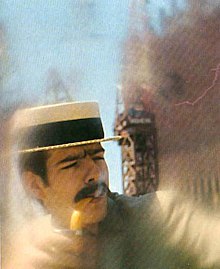
Chicano art affirms their cultural identity through religious iconography and cardinal elements of their Mexican, U.Due south., and indigenous cultures. For example, la Virgen de Guadalupe, of whom is an important figure in Mexican civilisation, is used in a socio-political context by Chicano artists every bit a symbol of both hope in times of suffering, and empowerment, particularly when embodying an average adult female or portrayed in an act of resistance. Mexican and indigenous civilisation is celebrated through the practices of their ancestors (shrines, dance, murals, etc.). Every bit new generations come to pass, art plays a function in educating Chicano youth near essential histories, traditions and values of their identity. Ane of the near celebrated holidays in Mexican culture is the Solar day of the Expressionless. The holiday focuses on gatherings of family and friends to pray for and remember family and friends who take died. The national holiday is celebrated in connection with the Catholic holidays of All Saints' Twenty-four hour period on November 1 and All Souls' Day on November 2.[24] Since it is then central to Mexican religious and cultural traditions, Mean solar day of the Expressionless has become a major component of Chicano art.

Traditions connected with the holiday include the building of private altars honoring the deceased using carbohydrate skulls or marigolds and visiting the deceased with gifts of their favorite foods or beverages.[25] Chicanos are able to affirm their cultural, indigenous and religious identities through daily life in the barrio, and artists draw upon these traditions, experiences and images, such equally sugar skulls and La Virgen de Guadalupe, in their artwork to reverberate the importance of self-conclusion and cultural divergence to Chicanos.
Mesoamerica, a region extending southward and due east from primal United mexican states to include parts of Guatemala, Belize, Republic of honduras, and Nicaragua, is a mutual theme in Chicano fine art, expressing their shared, however diverse civilization and identity. Going back to pre-Columbian times, Mesoamericans were inhabited past highly advanced civilizations, with their own political system, agronomics organisation, mythology, writing systems, and calendars. From these roots, the emergence of radiant Chicano art were traced. Indigenous heritage of Chicanos helps suffice why some activists during the Chicano Move and beyond portrayed Mesoamerican and Aztlan imagery in their art.[26] "The adoption of indigenous Mesoamerican imagery allowed Chicanas/os to assert an ethnic identity and, more importantly, helped to build a communal sensibility based on spiritual and cultural concepts".[27] Aztlan, a mythic region expanding from the U.S. Southwest to Mexico, is common theme in Chicano art as an expression of cultural nationalism. "The powerful symbolism of Aztlan as an ancestral homeland emanated from the deep Chicana/o sense of dislocation and deterritorialization experience in the aftermath of the Mexican–American War, which resulted in the annexation by the U.s. of the northern territories of Mexico, too as the before Spanish colonial invasion". Demands from Chicanos for equality and social justice have roots in this long history of loss and deportation. Furthermore, Aztlan and the reclamation of their indigenous roots has go a symbol for belonging for many Chicanos, in a nation that often discriminates, demonizes and criminalizes Mexican-Americans and Latinos as a whole. "Artists, activists, and cultural workers focused on the integration of ethnic thought through the choice, reclamation, and preservation of the cultural practices considered essential to combating oppressive stance of larger club".[28] Many Chicanos preserve their connectedness to their Aztec heritage by incorporating Aztec imagery (Quetzalcoatl, goddesses and gods, livelihood, temples, etc.) into their art, from murals to prints to performance trip the light fantastic to music, as a way for historical and cultural affirmation.
Chicano art as life in the barrio [edit]

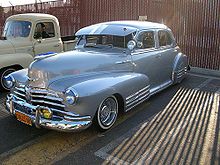
Another expression of Chicano identity through their art is their depictions of life in the barrio - Spanish-speaking, Latino neighborhoods in a city or town. Often the barrios, every bit ethnic enclaves, have long histories of dislocation, marginalization, poverty, and inequity in access social services. In the U.s.a., barrios can as well refer to the geographical "turf" claimed by Latino gangs, nigh normally express to Chicano gangs in California. Withal, it was in these barrios that the well-nigh interesting forms of fine art were fabricated past the Chicano community, particularly lowrider cars and bicycles, and graffiti.[26] A very popular fashion of automobile, even to this twenty-four hours, emerged from Chicano barrios, known as a "Lowrider." A lowrider is a mode of car that sits lower to the ground than nigh other cars. Many lowriders have their suspension systems modified with hydraulic pause then that the car tin can alter height at the flip of a switch.[29] Lowriding originated in the 1930s and blossomed in Southwestern Chicano communities during the mail-state of war prosperity of the '50s. Initially, youth who were dressed in the "pachuco" style would place sandbags in the torso of their customized cars in gild to create a lowered effect. Even so, this method was apace replaced by lowering blocks, cut leap coils, z'ed frames and driblet spindles. The goal was to cruise every bit slowly as possible and then that people could encounter what types of customizations were washed to your car.[29] Lowrider customizations consist of dominicus visors, fender skirts, bug deflectors, and swamp coolers. Expensive custom paint jobs are as well mutual such as metallic oxide flake or pearl flake, clear coat, metal leafage, airbrushed murals or script, pinstripes, and flames. Aureate or chrome spoke wheels or rims such every bit Astro Supremes, Cragers, Tru spokes, Crowns, Daytons and Zeniths are as well common.[29] Many cars have the modification of having suicide doors, or doors which open in the opposite management to a standard car door, scissor doors that open vertically, or gull-wing doors that open towards the roof, swinging up. Since the early 1990s, lowriders have go common in urban youth culture in full general, primarily in Due west Declension hip hop.[29] The lowriding scene is diverse including many different cultures, vehicle makes and visual styles, however it remains an important office of the Chicano customs and identity.
Chicano art even embraced the vandalistic expressions of graffiti. Art in the barrio also incorporates graffiti as a form of artistic expression, often associated with subcultures that rebel confronting authority. Graffiti has origins in the ancestry of hip hop culture in the 1970s in New York City, aslope rhyming, b-boying, and beats. It was used to publicly display their creative expressions with their social and political opinions in response to their lack of access to museums and art institutions, and the continuous strife, bigotry, and struggle of living in the metropolis. Because graffiti is illegal in most cases, this grade of art has flourished in the underground, requiring little money and providing an opportunity to vocalisation what is often excluded from dominant histories and media. From here, although graffiti remains the major grade of street art, other mediums take evolved - including stenciling, stickers, and wheatpasting. Graffiti oft has negative associations with serving territorial purposes for gangs, displaying tags and logos that differentiate certain groups from others, therefore mark their "turf". Within Chicano barrios, gangs utilize their own form of graffiti or tagging to marker territory or to serve as an indicator of gang-related activities.[30] Gang members likewise often utilise graffiti to designate membership, differentiate rivals and alliances, and mark ideological borders. Imagery of gang-related graffiti frequently consists of cryptic symbols and initials with unique calligraphy styles. Graffiti is arguably perceived as unacceptable, claimed to degrade the "await" or value of backdrop' walls or buildings in a way that is not presentable.
On the other paw, Chicano artists as well use graffiti as a tool, to express their political opinions, ethnic heritage, cultural and religious imagery, and counter-narratives to dominant portrayals of Chicano life in the barrios. Similar to other forms of art within the Chicano Motility (silk-screen printing, murals, etc.), graffiti has become another tool of resistance, reclamation, and empowerment every bit Chicanos brand their own space for expression and popular didactics. Graffiti is at present commonly recognized every bit a form of public art, embraced past museums, art critics, and art institutions. Only its significance for many Chicanos remains in the barrios, reiterating the importance of accessibility and inclusion in relation to their identity and community in their artwork. In times of disharmonize, such murals take offered public modes communication and self-expression for members of these socially, ethnically and racially marginalized communities, and have become effective tools in facilitating dialogue, challenging injustices and stereotypes that touch on their neighborhoods and peoples, and in the finish, elevating their customs.
Rasquachismo is very much a part of Chicano fine art. Information technology involves doing more with less, and is a reflection of the socioeconomic and political situation that many Chicanos grew upward with.[7] Using everyday materials, such equally paper plates, and elevating it into art, is one type of rasquachismo.[seven] Other examples contrast low and high art subjects.[seven]
Important exhibitions and collections [edit]
- Cheech Marin Collection: the largest individual collection of Chicano art, collected by Cheech Marin.[31] The Cheech Marin Eye for Chicano Fine art, Civilization & Industry is currently beingness developed to house the drove in Riverside, California.
- Chicano Art: Resistance and Affirmation (CARA): a touring exhibition that visited ten U.s. cities from 1990 to 1993.
- Chicano Visions: American Painters on the Verge: a touring exhibition which visited twelve cities from 2001to 2007.
Chicano cultural centers [edit]
- Artery 50 Gallery, Highland Park, California
- Centro Cultural de la Raza, in San Diego's Balboa Park in California.
- Chicano Park in San Diego, California.
- Galería de la Raza, in San Francisco, California.
- Mexican Heritage Plaza, in San Jose, California.
- Mission Cultural Center for Latino Arts, in San Francisco, California
- Plaza de la Raza Gallery, Los Angeles, California.
- Self-Assistance Graphics and Art Inc, in Los Angeles, California.
- Social and Public Fine art Resource Middle (SPARC), in Venice, California.
Museums and galleries focusing on Chicano art [edit]
- Galería de la Raza in San Francisco, California
- Mexic-Arte Museum in Austin, Texas
- Movimiento de Arte y Cultura Latino Americana (MACLA) in San Jose, California
- Museo Eduardo Carrillo an online museum
Quotes [edit]
"Chicano fine art is the modern, ongoing expression of the long-term cultural, economic, and political struggle of the Mexicano people within the United States. It is an affirmation of the circuitous identity and vitality of the Chicano People. Chicano art arises from and is shaped past our experiences in the Americas."—Founding Statement of the CARA National Advisory Committee, July 1987[32]
"Arte Chicano has frequently been stereotyped as being extremely political. True enough, some of it does reflect the socio-political struggle of Chicanos, but that is not exclusively what it deals with or is about. It is not the artistic arm of whatever detail political ideology. It is the art of a people, of Chicanos equally a cultural entity."—Los Quemados, 1975[33]
Come across also [edit]
- Nepantla
References [edit]
- ^ Quirarte, Jacinto (1973). Mexican American Artists. Austin, Texas: Academy of Texas Press. Retrieved nine Apr 2015.
- ^ a b Hutchinson, Sharla (October 2013). "Recoding Consumer Culture: Ester Hernandez, Helena Maria Viramontes, and the Farmworker Crusade". Journal of Popular Culture. 46 (5): 973–990. doi:10.1111/jpcu.12063. ISSN 0022-3840.
- ^ a b c Goldman, Shifra M.; Ybarro-Frausto, Tomas (1991). "The Political and Social Contexts of Chicano Art". In Griswold del Castillo, Richard; McKenna, Teresa; Yarbro-Bejarano, Yvonne (eds.). Chicano Fine art: Resistance and Affirmation. Los Angeles, California: Wight Art Gallery, Academy of California Los Angeles. pp. 83–108. ISBN0943739152.
- ^ Rangel, Jeffrey (1997). "Oral history interview with Gronk, 1997 January. 20-23". Athenaeum of American Art. Smithsonian Institution. Retrieved viii April 2015.
- ^ Zamudio-Taylor, Virginia Fields, Victor (2001). The road to Aztlan : art from a mythic homeland : [publ. ... with the exhibition "The road to Aztlan", Los Angeles County Museum of Art, May 13 - August 26, 2001 ...] (one. ed.). Los Angeles: Los Angeles County Museum of Art. p. 348. ISBN978-0-8263-2427-6.
- ^ Zamudio-Taylor, Virginia Fields, Victor (2001). The road to Aztlan : art from a mythic homeland : [publ. ... with the exhibition "The road to Aztlan", Los Angeles County Museum of Art, May xiii - August 26, 2001 ...] (1. ed.). Los Angeles: Los Angeles Canton Museum of Art. p. 342. ISBN978-0-8263-2427-six.
- ^ a b c d Mesa-Bains, Amalia (1993). Anniversary of Spirit: Nature and Memory in Gimmicky Latino Art. San Francisco, California: The Mexican Museum. pp. 9–17. ISBN1880508028.
- ^ Jackson, Carlos Francisco (2009). Chicana and Chicano art : ProtestArte ([Nachdr.] ed.). Tucson: University of Arizona Press. p. 99. ISBN978-0-8165-2647-5.
- ^ Jackson, Carlos Francisco (2009). Chicana and Chicano art : ProtestArte ([Nachdr.] ed.). Tucson: University of Arizona Press. p. 106. ISBN978-0-8165-2647-5.
- ^ a b c d Brookman, Philip (1986). "El Centro Cultural de la Raza, Fifteen Years". In Brookman, Philip; Gomez-Pena, Guillermo (eds.). Made in Aztlan. San Diego, California: Centro Cultural de la Raza. pp. xix–21. ISBN0938461001.
- ^ Dear, M. J.; Leclerc, Gustavo; Berelowitz, Jo-Anne, eds. (2003). Postborder city : cultural spaces of Bajalta California. New York [u.a.]: Routledge. p. 147. ISBN978-0-415-94420-5.
- ^ a b Dear, K. J.; Leclerc, Gustavo; Berelowitz, Jo-Anne, eds. (2003). Postborder urban center : cultural spaces of Bajalta California. New York [u.a.]: Routledge. p. 150. ISBN978-0-415-94420-v.
- ^ Love, M. J.; Leclerc, Gustavo; Berelowitz, Jo-Anne, eds. (2003). Postborder city : cultural spaces of Bajalta California. New York [u.a.]: Routledge. p. 148. ISBN978-0-415-94420-v.
- ^ Fuentes, Ed (five March 2015). "Monthly Mural Wrap: A Dozen Tags for March, 2014". KCET . Retrieved 11 Apr 2015.
- ^ Zamudio-Taylor, Virginia Fields, Victor (2001). The road to Aztlan : art from a mythic homeland : [publ. ... with the exhibition "The route to Aztlan", Los Angeles County Museum of Fine art, May 13 - Baronial 26, 2001 ...] (1. ed.). Los Angeles: Los Angeles County Museum of Fine art. p. 336. ISBN978-0-8263-2427-6.
- ^ a b Acosta, Teresa Palomo (12 June 2010). "Chicano Landscape Movement". Handbook of Texas Online. Texas State Historical Association. Retrieved 8 Apr 2015.
- ^ Jackson, Carlos Francisco (2009). Chicana and Chicano art : ProtestArte ([Nachdr.] ed.). Tucson: University of Arizona Press. p. 75. ISBN978-0-8165-2647-5.
- ^ Jackson, Carlos Francisco (2009). Chicana and Chicano art : ProtestArte ([Nachdr.] ed.). Tucson: University of Arizona Press. p. 76. ISBN978-0-8165-2647-five.
- ^ Jackson, Carlos Francisco (2009). Chicana and Chicano fine art : ProtestArte ([Nachdr.] ed.). Tucson: University of Arizona Press. p. 156. ISBN978-0-8165-2647-v.
- ^ Jackson, Carlos Francisco (2009). Chicana and Chicano art : ProtestArte ([Nachdr.] ed.). Tucson: University of Arizona Press. p. 157. ISBN978-0-8165-2647-5.
- ^ Jackson, Carlos Francisco (2009). Chicana and Chicano fine art : ProtestArte ([Nachdr.] ed.). Tucson: Academy of Arizona Press. p. 160. ISBN978-0-8165-2647-five.
- ^ Jackson, Carlos Francisco (2009). Chicana and Chicano art : ProtestArte ([Nachdr.] ed.). Tucson: University of Arizona Press. p. 161. ISBN978-0-8165-2647-v.
- ^ Korten, Alicia Epstein (2009). "Transforming Business Structures for Communities". Modify Philanthropy: Candid Stories of Foundations Maximizing Results through Social Justice. San Francisco, California: Jossey-Bass. pp. 70–72. ISBN9780470522110 . Retrieved 2 Apr 2015.
- ^ Jackson, Carlos Francisco (2009). Chicana and Chicano art : ProtestArte ([Nachdr.] ed.). Tucson: University of Arizona Press. ISBN978-0-8165-2647-5.
- ^ "The Day of the Expressionless". Día de los Muertos Alphabetize. Access Mexico Connect.
- ^ a b Galindo, Steve. "Life in the Barrio". Retrieved 15 Dec 2011.
- ^ Zamudio-Taylor, Virginia Fields, Victor (2001). The road to Aztlan : fine art from a mythic homeland : [publ. ... with the exhibition "The road to Aztlan", Los Angeles County Museum of Fine art, May 13 - August 26, 2001 ...] (1. ed.). Los Angeles: Los Angeles Canton Museum of Fine art. p. 332. ISBN978-0-8263-2427-six.
- ^ Zamudio-Taylor, Virginia Fields, Victor (2001). The road to Aztlan : art from a mythic homeland : [publ. ... with the exhibition "The road to Aztlan", Los Angeles County Museum of Art, May xiii - August 26, 2001 ...] (ane. ed.). Los Angeles: Los Angeles County Museum of Fine art. p. 333. ISBN978-0-8263-2427-6.
- ^ a b c d Arredondo, David. "Lowrider History (The Good Old Lowrider Controversy)". Retrieved fifteen December 2011.
- ^ Stowers, George. "Graffiti Art". Archived from the original on xi January 2010. Retrieved 15 Dec 2011.
- ^ Marin, Cheech. "Chicano Fine art". Cheech . Retrieved viii Apr 2015.
- ^ Griswold del Castillo, Richard; McKenna, Teresa; Yarbro-Bejarano, Yvonne, eds. (1991). Chicano Fine art, Resistance and Affirmation, 1965-1985. Los Angeles, California: Wight Art Gallery, University of California Los Angeles. p. 27. ISBN0943739152.
- ^ Artistas Chicanos Los Quemados. San Antonio, Texas: Instituto Cultural Mexicano. 1975. Retrieved nine April 2015.
Further reading [edit]
- Goldman, Shifra M.; Ybarra-Frausto, Tomás (1985). Introduction. Arte Chicano: A comprehensive annotated bibliography of Chicano art, 1965-1981. Berkeley: UC Berkeley, Chicano Studies Library Publication Unit. pp. 3–59. OCLC 13804303.
External links [edit]
- Rappaport, Emily (2015-09-xxx). "This L.A. Delivery Human Clustered One of the Globe's Largest Collections of Chicano Fine art". Artsy.
Source: https://en.wikipedia.org/wiki/Chicano_art_movement
0 Response to "Art and Identity in Mexican and Chicano Social Movements"
Post a Comment